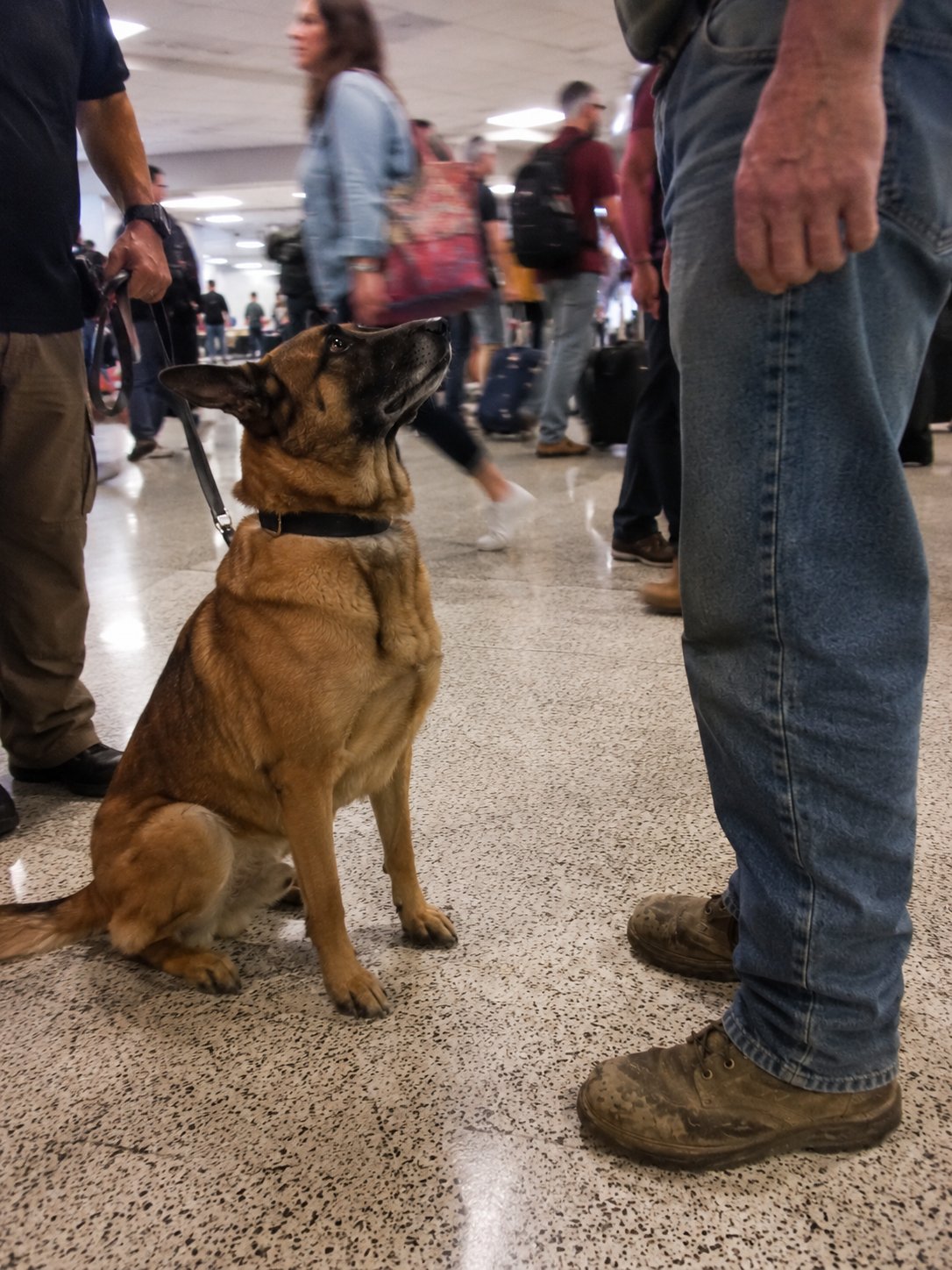
The retired military dog stopped walking in the airport.
Sat at attention. Left paw raised.
In front of a stranger’s boots he hadn’t seen in seven years.
Marcus Grant was halfway through baggage claim when the German Shepherd stopped walking.
The dog’s handler—a young woman in her twenties—jerked to a halt as the leash went taut. “Rico, come on,” she said, tugging gently.
The dog didn’t move. He sat. Perfectly still. Left paw raised slightly off the ground.
Marcus felt his throat close.
That sit. That exact posture.
The woman tugged again. “I’m so sorry,” she called to Marcus, who had frozen three feet away. “He never does this—”
“What’s his name?” Marcus’s voice came out wrong.
“Rico. He’s a retired MWD—military working dog. I adopted him six months ago from the veteran program, but he’s been—”
Marcus’s hand moved to his jacket pocket. His fingers found the dog tag he’d carried for seven years. The one they’d sent him after the medical discharge. After the explosion that took his leg and ended both their deployments.
Rico’s tag. K9 Handler: SFC Marcus Grant.
“Rico,” Marcus said quietly.
The dog’s ears snapped forward. His entire body went rigid.
Marcus took one step closer. His prosthetic leg made a faint mechanical sound as his weight shifted.
Rico’s head tilted. His nostrils flared.
Then the dog broke.
He lunged forward so hard the leash ripped from the woman’s hand. But he didn’t jump. He sat again—harder this time—directly against Marcus’s right leg. The prosthetic one. Pressed his shoulder against the boot exactly where he’d been trained to guide during patrol sweeps in Kandahar.
Marcus’s knees gave out.
He went down hard on the airport floor, and Rico climbed into his lap—all seventy pounds of him—the way he used to after missions when the adrenaline wore off and they were finally alone in the kennel.
The dog was shaking. Marcus was shaking.
“I looked for you,” Marcus whispered into Rico’s fur. “They told me you’d been reassigned. They told me you were still deployed. I looked—”
Rico pressed his nose against Marcus’s jacket pocket. The one with the tag.
The woman stood five feet away, both hands over her mouth. A small crowd had formed. Nobody moved.
Marcus pulled the dog tag from his pocket with trembling fingers and held it up. Same name. Same number.
Rico took it gently in his mouth, the way he’d been trained to retrieve, and placed it on the ground between them.
Then he sat again. Left paw raised. Waiting for orders.
Marcus’s vision blurred. He hadn’t given this dog a command in seven years. Hadn’t been his handler since the day the IED went off and they were both medevaced to separate hospitals on separate continents.
“At ease,” Marcus finally whispered.
Rico dropped his paw, circled once, and lay down across Marcus’s legs.
The woman crouched down slowly. Her eyes were red. “I didn’t know,” she said. “The adoption papers—they didn’t say—” She stopped. “He’s been waiting at the window every morning. Just sitting there. I thought he was watching birds.”
Marcus looked down at Rico, whose eyes had finally closed.
“He wasn’t watching birds,” Marcus said.
The crowd around them had gone completely silent. An older man in a Vietnam Veteran cap stood with his hand over his heart. A TSA agent had stopped mid-stride, radio halfway to his mouth.
The woman’s voice was barely a whisper. “Do you want him back?”
Marcus’s hand found the thick scar on Rico’s shoulder—shrapnel from the same blast that took Marcus’s leg. They’d been three feet apart when it happened. They’d bled on the same sand.
“I can’t—” Marcus’s voice cracked. “I’m in a studio apartment. I work sixty hours a week. I don’t have a yard. I don’t—”
Rico’s tail thumped once against the floor.
The woman sat down fully. She pulled something from her bag—a folder—and opened it. Adoption papers. She stared at them for a long moment.
Then she took a pen and wrote something on the back of her business card.
“My address,” she said, handing it to Marcus. “I have a house. Fenced yard. I work from home.” She looked at Rico, then back at Marcus. “But he’s not my dog. He never was.”
Marcus took the card. His hands were still shaking.
“You come see him whenever you want,” she said. “Every day if you need to. Weekends. Mornings. I don’t care.” Her voice broke. “But I’m not keeping him from you. Not again.”
Rico shifted, positioning himself so his weight pressed against both of them.
Marcus looked at the woman—this stranger who had loved his dog for six months, who was offering to share him with the handler he’d been trained to die beside.
“I’m Marcus.”
“Jenna.”
They sat there on the baggage claim floor for twenty minutes. Neither of them moved. The crowd eventually dispersed, but the Vietnam vet stayed, standing quiet watch from ten feet away.
When Marcus finally stood, Rico stood with him. Pressed against his right side. Exactly where he used to walk on patrol.
Jenna picked up the leash but didn’t pull.
“Tomorrow?” Marcus asked.
“Tomorrow,” Jenna said. “And every day after that if you want.”
Marcus knelt one more time. Rico licked his face once, then sat again—perfect and still—waiting.
“Good boy,” Marcus whispered. “Good boy.”
Rico’s tail wagged.
For the first time in seven years, Marcus felt the weight against his right leg that had been missing since the day the world exploded.
Jenna handed him the leash.
“Take him home,” she said. “Just bring him back to me tonight.”
Marcus nodded. He couldn’t speak.
They walked toward the exit together—Marcus, Rico, and Jenna—and for those thirty seconds, Rico walked between them, head high, the way he’d been trained.
The Vietnam vet saluted as they passed.
Marcus saluted back.