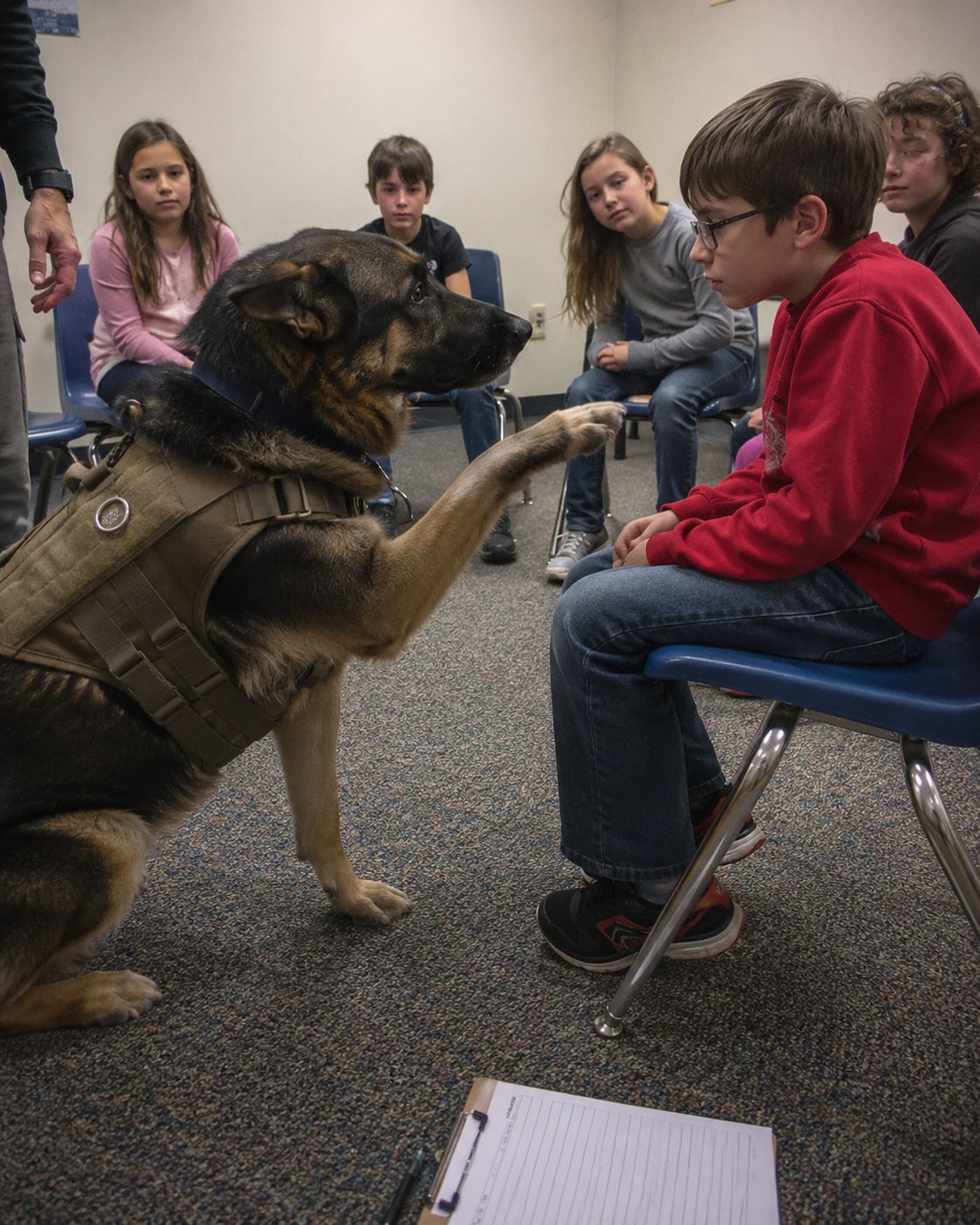
The boy hadn’t spoken in eight months.
Then the war dog sat in front of him and raised his paw.
The boy whispered one word.
—
The German Shepherd came through the double doors at 9:47 a.m., handler at his side, tags silent against his vest.
Eight children sat in a circle. Dr. Patel had explained the rules twice. Let the dog come to you. No sudden movements. This is Sergeant. He’s retired military. He’s here to help.
The boy in the red sweatshirt—Marcus, age seven—hadn’t made eye contact with anyone in the room for three weeks. His mother sat outside in the waiting area, hands folded, staring at nothing.
Sergeant moved slowly past each child. Sniffed. Sat. Moved on.
When he reached Marcus, he stopped.
The dog’s entire body went still. His ears flattened. His head lowered slightly, and he took two steps closer, then sat directly in front of the boy—close enough that his breath fogged the kid’s glasses.
Marcus didn’t move.
Sergeant raised his right paw. Held it there. Waiting.
Dr. Patel opened her mouth to redirect, but the boy’s hand was already moving.
Marcus placed his palm under the dog’s paw. His fingers closed around it.
Then he whispered something.
Dr. Patel leaned forward. “What did you say, Marcus?”
The boy’s lips barely moved. “Havoc.”
The handler’s clipboard hit the floor.
“What did you just say?”
Marcus looked up for the first time in eight months. His voice was small, cracked, but clear.
“His name is Havoc.”
The handler’s face went white. “That… that was his name. In Kandahar. We renamed him when he retired. How do you—”
Marcus’s hand was trembling now, still holding the dog’s paw. “My dad called him that. He sent me a picture. He said Havoc saved his whole unit.”
The room went silent.
Dr. Patel’s pen froze mid-note. “Marcus, your father—”
“He died there.” Marcus’s voice cracked. “Two years ago. He wrote me about Havoc in his last letter.”
The handler crouched down slowly, his breath uneven. “Your dad… what was his name?”
“Sergeant Luis Alvarez. Third Battalion.”
The dog let out a low whine and pressed his nose against Marcus’s chest—exactly where a handler would keep his photo pocket.
The handler’s hand went to his mouth. “Havoc wouldn’t eat for three days after your dad… after Luis…” His voice broke. “We thought he was just grieving the loss. We didn’t know he understood.”
Marcus buried his face in the dog’s neck.
The dog didn’t move. Didn’t pull away. Just held absolutely still while the boy’s body shook with two years of silence finally breaking open.
Dr. Patel’s notes blurred on the page.
The other children sat frozen, watching something none of them understood but all of them felt.
The handler knelt beside them both, one hand on the dog, one hand hovering near the boy’s shoulder. “He never stopped looking. Every time we’d get off the transport… he’d search faces. Every single time.”
Marcus pulled back just enough to look at the dog. His glasses were fogged, his face wet. “You remember him?”
Havoc’s tail moved once. Twice.
Then the dog laid down and rested his head across the boy’s lap.
Marcus’s small hand found the tag on the vest. He turned it over.
On the back, engraved in small letters beneath the official ID number:
*K9 Havoc – 3rd Battalion – In memory of the handlers who brought me home*
And below that, scratched in by hand, barely visible:
*L.A. – Always.*
The boy’s shoulders collapsed inward.
The handler’s voice was barely a whisper. “He carved that the night before the convoy. Said if anything happened to him, Havoc would know.”
Marcus looked up, his face broken open. “He knew my dad?”
“Your dad saved his life. Pulled him out of a collapsed building. Carried him two miles.” The handler’s jaw tightened. “Havoc was with him when… at the end. He wouldn’t leave. They had to pull him away.”
The boy’s breath hitched, but he didn’t look away from the dog.
Dr. Patel set her clipboard down silently.
Marcus whispered, “Does he know my dad’s gone?”
The handler nodded. “Yeah, buddy. He knows.”
The dog’s eyes never left the boy’s face.
Marcus leaned forward and pressed his forehead against Havoc’s. “My dad said you were the bravest.”
The dog’s tail swept the floor once.
The boy stayed like that—forehead to forehead, eyes closed, breath finally steady—for a long time.
When Marcus’s mother came to pick him up an hour later, she found her son sitting quietly with his hand on the dog’s neck, whispering something she couldn’t hear.
Dr. Patel stood in the hallway, watching.
The handler was on the phone, his voice low but firm. “I need to fast-track an adoption clearance. Therapy animal placement. Family of a fallen handler.”
Marcus didn’t look up when his mom arrived. He just held the dog tighter.
Havoc didn’t move.
Three weeks later, the dog came home.
Marcus still didn’t talk much. But every morning, he’d sit on the floor with Havoc and show him pictures from the box his mom kept under her bed—pictures of a man in uniform, smiling, one hand on a German Shepherd’s head.
Havoc would press his nose against the photos.
And Marcus would whisper, “He loved you too.”
—