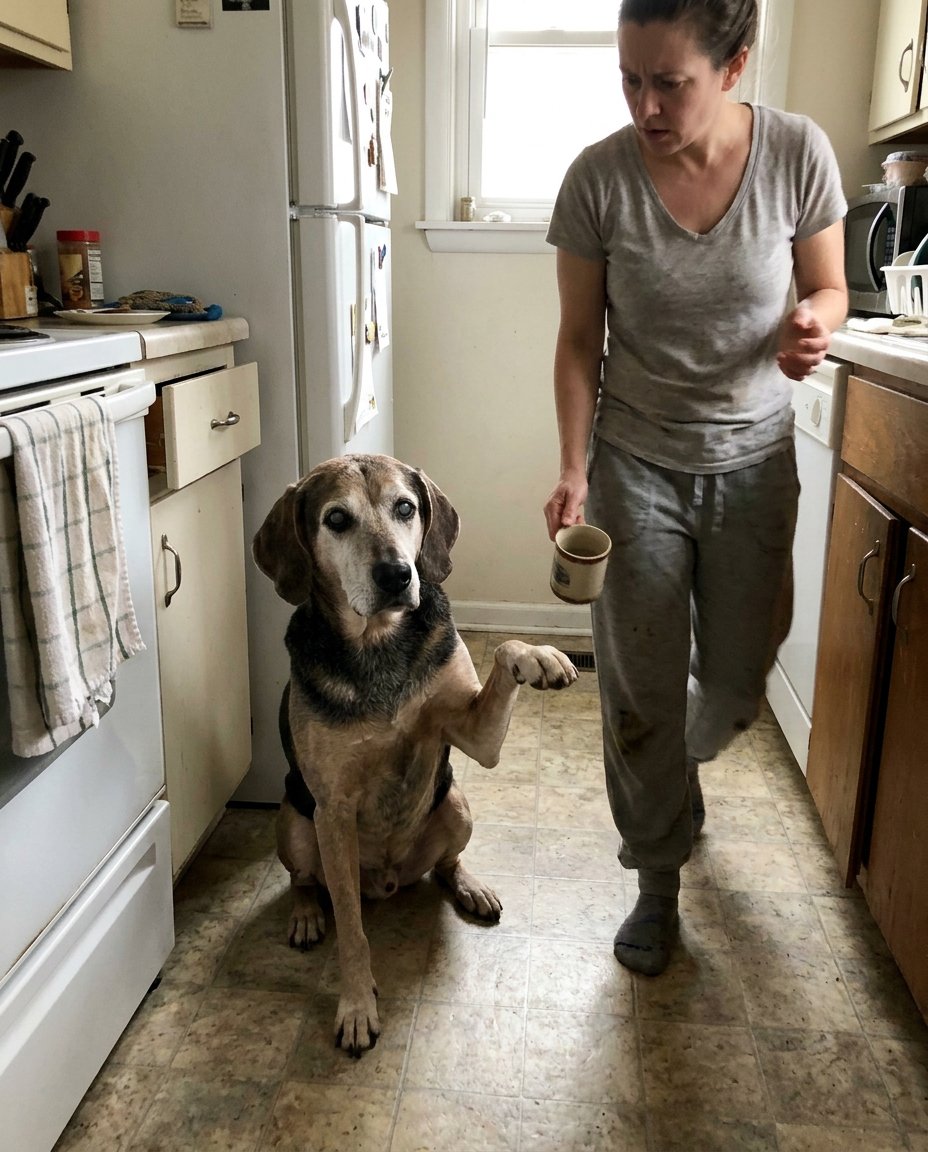
She adopted a senior dog nobody wanted.
Three days later, he walked to a kitchen drawer and raised his paw.
She’d never taught him that command…
—
Marissa hadn’t opened the junk drawer in the kitchen since her mother died eight months ago. She’d avoided it the way you avoid certain songs on the radio.
The hospice social worker told her getting a dog might help. So on a Tuesday morning, she went to the county shelter and asked for the one nobody wanted.
They brought out a twelve-year-old hound mix named Beau. Gray muzzle. Cloudy left eye. Three months past his “last chance” date because the shelter director couldn’t bring herself to make the call.
“He’s got maybe a year,” the tech said. “Arthritis. Doesn’t hear well. Sleeps twenty-two hours a day.”
Marissa signed the papers.
For two days, Beau barely moved from the dog bed she’d set up in the living room. Drank water. Ate half his food. Slept.
On the third morning, she was making coffee when she heard his nails clicking on the tile.
He walked straight past her. Didn’t sniff. Didn’t explore.
He stopped at the narrow drawer beside the refrigerator—the one crammed with old takeout menus, expired coupons, her mother’s reading glasses—and sat. Stiff. Formal.
Then he lifted his left paw and held it in the air.
Marissa stared at him.
“I didn’t teach you that,” she said.
Beau didn’t move. His paw stayed raised. His body stayed locked in position.
She crouched down. Her hands were shaking.
“Why this drawer?”
He didn’t blink.
She pulled the drawer open. Menus slid forward. She pushed them aside. Underneath was a small purple envelope she’d forgotten about—one her mother had pressed into her hand the day before she went into hospice.
*”Not yet,”* her mom had whispered. *”You’ll know when.”*
Marissa had shoved it in the drawer and never looked at it again.
She pulled the envelope out now.
Beau dropped his paw. His tail gave one slow thump against the floor.
Her pulse was pounding in her ears.
She turned the envelope over. On the back, in her mother’s handwriting:
*For Beau. So he knows you’re safe now.*
Marissa’s breath stopped.
She looked at the dog. He looked back at her with his one good eye.
“You were hers,” she whispered.
Beau stood slowly. Walked to her. Pressed his gray muzzle into her knee.
Her throat locked. The envelope slipped from her hand.
She didn’t know her mother had a dog. Her mother had lived alone for six years. Never mentioned it. There were no photos. No dishes. No leash by the door.
She pulled out her phone with trembling fingers and called the shelter.
The director picked up on the second ring.
“Beau,” Marissa said. Her voice cracked. “Who surrendered him?”
There was a pause.
“Hospice nurse,” the director said quietly. “Three months ago. Said the owner passed and there was no family to call. No instructions. Just asked us to try.”
Marissa’s jaw clenched. Her mother had spent her last months making sure this dog would survive her. Had arranged his surrender. Had left him one final job.
Find her daughter. Lead her to the letter.
She sank onto the kitchen floor. Beau climbed carefully into her lap—something he hadn’t done since she brought him home—and rested his chin on her shoulder.
The letter was still sealed.
She opened it with shaking hands.
Inside, five words in her mother’s handwriting:
*You were never alone, baby.*
Marissa’s breath came in jagged, broken pieces. She wrapped both arms around the old dog and pressed her face into his neck. He smelled like kibble and sleep and something faintly familiar she couldn’t name.
He didn’t move. Didn’t pull away.
Two shelter workers had walked past his kennel every day for three months and saw a dog too old to save.
Her mother had seen something else.
She’d seen the one soul who would wait as long as it took.
Marissa sat on the floor with him until the coffee went cold. Until the sun came through the window and painted the tile gold.
Beau’s tail thumped once more.
Then he closed his eyes and went to sleep in her arms.
—