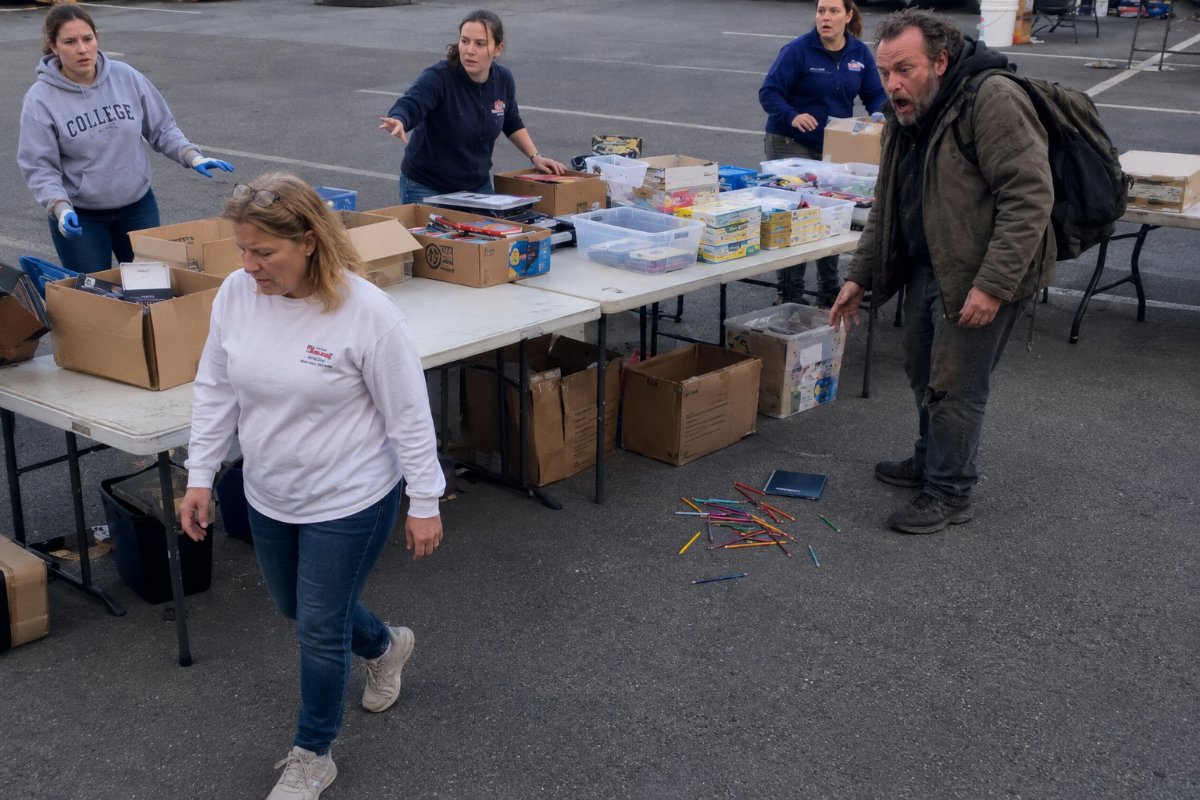
A homeless man opened a donated sketchbook.
Twelve pencils fell from his hands.
He was staring at a drawing of himself from the worst day of his life.
—
The art supply recycling event outside the community college runs until 3 p.m. Karen pulls into the parking lot at 2:47 with a cardboard box she’s been packing and unpacking for nine months.
Inside: brushes, watercolors, charcoal sticks. All unused. Her daughter Mia bought them two weeks before the car accident. She was nineteen. She’d just changed her major to illustration.
Karen had finally opened Mia’s sketchbook last night. Just once. Just the first page.
A volunteer directs her to a folding table where donated supplies are being sorted. Karen sets the box down. Her throat tightens when she sees the sketchbook on top. Navy blue cover. Mia’s name in silver Sharpie on the spine.
“Thank you so much,” the volunteer says, already reaching for the charcoal.
Karen nods. Turns to leave. She makes it four steps.
Behind her, someone gasps. Sharp. Loud enough that two other volunteers look up.
She turns back.
A man in his fifties—worn jacket, overstuffed backpack, dirt under his fingernails—stands frozen at the table. He’s holding Mia’s sketchbook open. His hands are shaking so badly the pages flutter. Twelve colored pencils lie scattered at his feet where he dropped them.
He’s staring at the first page. The only page Mia ever drew in.
His mouth opens. Closes. He looks up at Karen with wet eyes and something like terror.
“Where did you get this?”
Karen steps closer. Her voice barely works. “My daughter. She… she died. Why?”
The man’s finger touches the sketch. A park bench. A tree. A man sleeping with a backpack.
“This is me,” he whispers.
Karen’s lungs stop.
“She drew this?” His voice cracks. “When?”
“September,” Karen says. “September ninth. Last year.”
The man’s knees buckle slightly. Someone steadies him.
“That was the worst day of my life,” he says. His tears fall onto the page. “I was sitting in that exact spot. Figuring out how to… I had a bottle of pills in my coat. I was gonna take all of them.”
The parking lot goes silent. Six people have stopped moving.
“Then this girl sat down,” he continues, his whole body trembling now. “She didn’t say anything. She just… sat there. Pulled out a sketchbook. Started drawing. I watched her for maybe twenty minutes. She smiled at me once. Just once. Then she left.”
He looks at Karen, his face breaking.
“I threw the pills away. I don’t know why. But I threw them away.”
Karen’s vision blurs. She reaches for the table to stay upright.
The man holds the sketchbook like it weighs nothing and everything.
“I never saw her again,” he whispers. “I looked for her. I wanted to tell her she saved my life and she didn’t even know it.”
Karen’s jaw locks. The photograph in her wallet. Mia. Smiling.
She pulls it out with shaking fingers. Holds it up.
The man’s breath catches. He nods once. Twice. His shoulders collapse inward.
“That’s her.”
Karen can’t speak. Can’t breathe. The world tilts.
The volunteer steps back. Two others are crying.
The man closes the sketchbook carefully. Presses it to his chest.
“Can I…” His voice breaks completely. “Can I keep this?”
Karen’s throat unlocks. She nods. Once.
“She’d want you to,” Karen whispers.
The man hugs the sketchbook tighter. His whole body shakes with silent sobs.
Karen steps forward. Her hand reaches out. Trembling. She touches his shoulder.
They stand there. Two strangers. Connected by a girl who smiled once and never knew what it meant.
The September light catches the silver Sharpie on the spine. Mia’s handwriting.
The man doesn’t let go.
Neither does Karen.
—