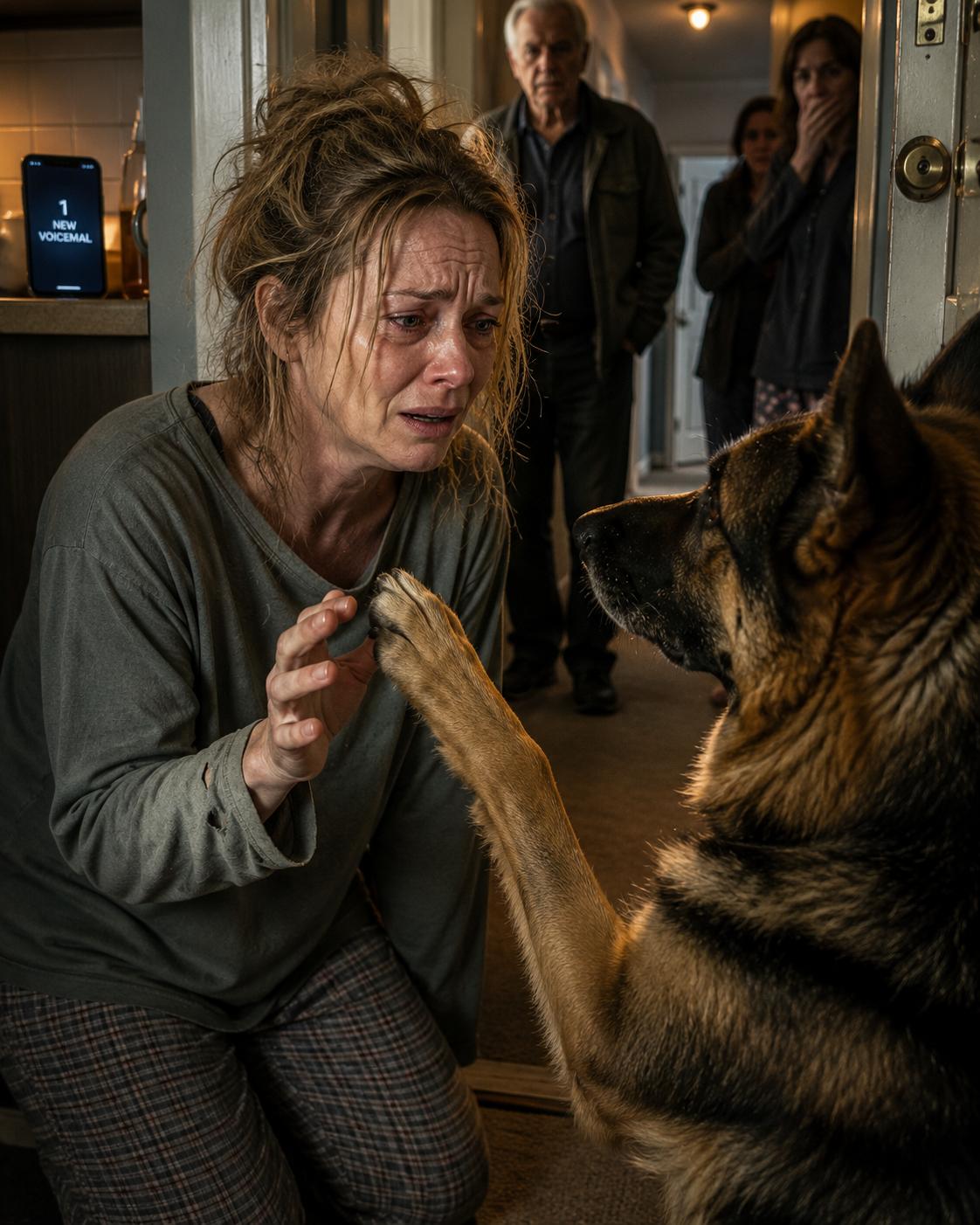
The dog raised his left paw and held it in the air.
The exact command her husband used to teach their dog.
But her husband died three months ago.
—
The German Shepherd started appearing at Carol’s door on Tuesday.
Six forty-three a.m. Three soft scratches. Then silence.
Carol didn’t answer. She was still in yesterday’s clothes, sitting on the kitchen floor, staring at her phone screen. The voicemail icon had shown “1 new message” for nine days. She couldn’t make her thumb press it.
Wednesday. Same time. Three scratches.
Thursday. Friday. Saturday.
Carol stopped getting up. She just listened from the floor.
Sunday morning, the scratches came again. But this time they didn’t stop.
Scratch. Pause. Scratch. Pause.
Carol’s hand trembled as she finally stood. Her legs barely held her. She hadn’t showered in six days. Hadn’t eaten in two. The apartment smelled like unopened mail and unwashed grief.
She opened the door.
The dog sat immediately. A massive German Shepherd with intelligent brown eyes. No collar. Behind him, fifteen feet back on the sidewalk, stood a man in his sixties—her neighbor from 4C, someone she’d never spoken to.
The dog stared at her. Then did something that made her breath catch.
He raised his left paw. Held it steady in the air. The exact way her husband used to train their dog to do before meals.
“Wait for permission,” David used to say.
But David had been gone for three months. Their dog had died two years before that. This dog had never met either of them.
Carol’s jaw locked. “How—”
“His name’s Bishop,” the man said quietly. “I’m Tom. We’re in 4C.”
“I don’t understand.”
Tom took one step closer. His face was careful. Kind. “Bishop was a service dog. PTSD detection. He washed out of the program because he wouldn’t stop alerting on people who weren’t his handler.” He paused. “He alerts when someone’s in crisis. When they’ve been alone too long. When they’re not safe.”
Carol’s throat closed.
“He’s been sitting outside my door every morning at six-thirty for two years,” Tom continued. “Helped me get up. Helped me keep going after my daughter died.” His voice stayed steady. “Then six days ago, he stopped coming to my door. Started coming to yours instead.”
Carol looked down at the dog. Bishop was still holding his paw up. Still waiting.
Her vision blurred. “I don’t—I can’t—”
“You don’t have to explain,” Tom said. “I’m not here to ask questions. I just wanted you to know.” He gestured to Bishop. “He won’t leave until you give him permission. That’s how he works. He waits until you’re ready.”
Carol stared at the raised paw. At the patient brown eyes. At this impossible dog who somehow knew she’d been sitting on her kitchen floor for six days, unable to press play on her husband’s last voicemail, unable to move forward, unable to let go.
Her knees buckled.
She didn’t fall. She just slowly sank down until she was kneeling in her doorway. Bishop lowered his paw and stepped forward, pressing his weight against her chest.
Tom stayed where he was. Didn’t move closer. Just spoke quietly.
“I have coffee on. It’s terrible coffee, but it’s hot. And if you want to just sit in silence, that’s fine. Bishop usually stays until about nine.”
Carol’s hands finally moved. They curled into the dog’s fur. Her breath came in short, broken gasps.
“I haven’t listened to it,” she whispered.
Tom nodded slowly. “You will. When you’re ready.”
She looked up at him. “How do you know?”
“Because you opened the door,” he said.
Bishop didn’t move. Just kept his steady weight against her, his breathing slow and even.
Behind Tom, two people walking to their cars had stopped. They stood frozen on the sidewalk, watching. One woman had her hand pressed to her mouth.
Carol stayed kneeling. The dog stayed pressed against her. The impossible, unexplainable weight of him holding her upright.
Tom waited thirty seconds. Then he spoke again, quieter.
“I’ll be in 4C. Door’s unlocked.”
He turned and walked back toward the building. Bishop stayed.
Carol’s fingers trembled in his fur. She looked down at the dog—this stranger’s dog, this impossible dog who had somehow known she needed him more than his owner did.
“Okay,” she whispered.
Bishop’s tail moved once. Slow. Deliberate.
She stayed kneeling in her doorway for four more minutes. The dog didn’t move. The witnesses didn’t move.
Finally, she stood. Her legs shook. Her whole body shook.
Bishop stood with her.
She looked toward 4C. The door was open. Light spilled into the hallway.
Carol took one step. Then another.
Bishop walked beside her.
Behind them, her apartment door stayed open. Inside, on the kitchen counter, her phone screen still glowed.
1 new voicemail.
She didn’t look back.
—