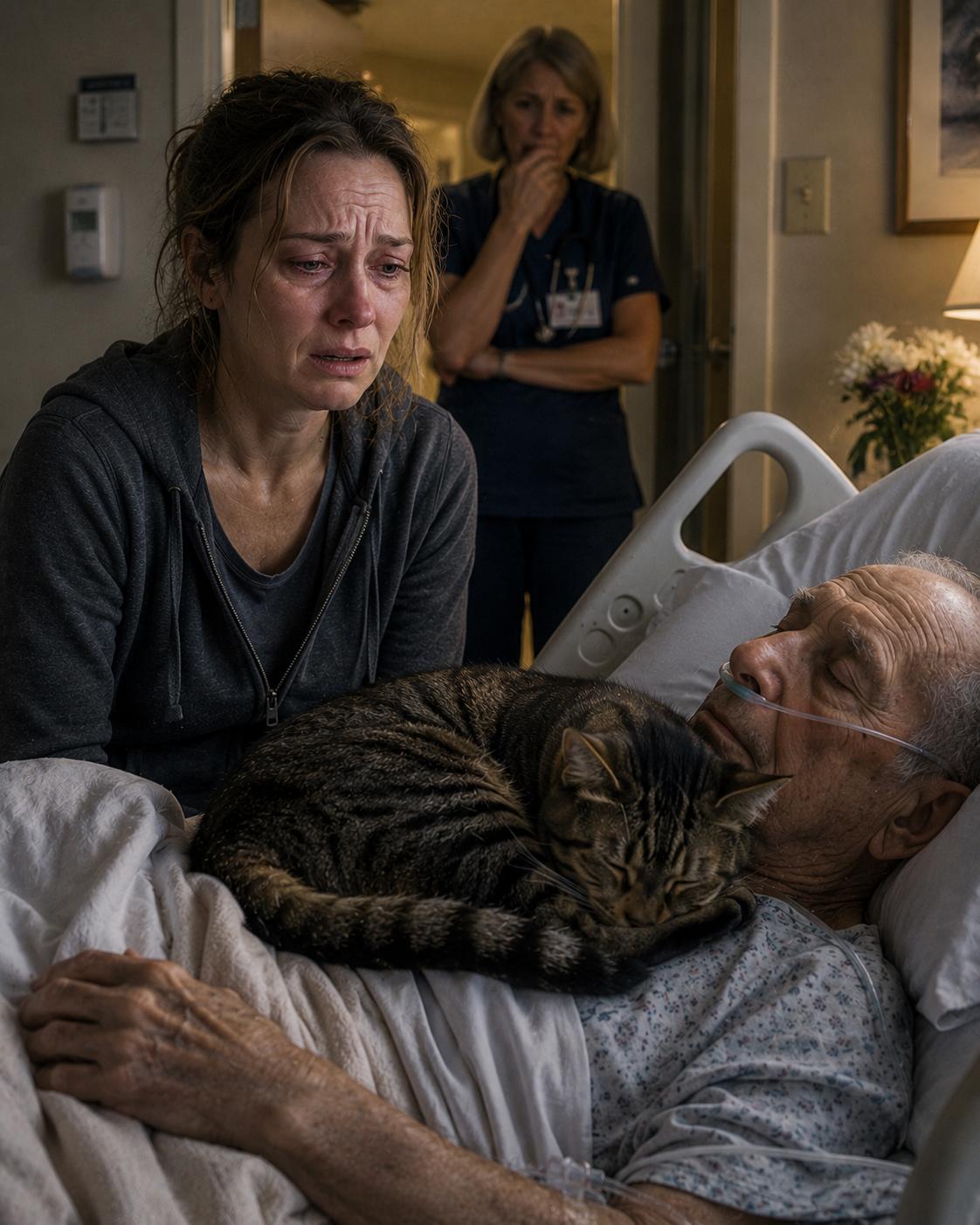
The hospice cat sat in her father’s room for six days.
The nurses said he’s never wrong.
She wasn’t ready to hear what that meant.
—
The tabby hadn’t moved from the windowsill in Room 14 for six days.
Marcy stopped in the doorway with fresh towels. The cat—Oscar, the hospice’s resident wanderer—sat pressed against the glass, staring at the parking lot below. He never stayed in one room longer than an hour. That’s what made him useful. That’s what made him bearable.
Her father slept in the bed behind Oscar, oxygen hissing softly. The skin around his knuckles had gone translucent.
“He’s just visiting, right?” Marcy asked the nurse passing in the hall.
The nurse glanced at Oscar. Her expression didn’t change. “We don’t move him when he chooses a room.”
“What does that mean?”
“It means he knows.”
Marcy’s throat tightened. “Knows what?”
The nurse hesitated. “In eleven years, Oscar’s never been wrong. When he stays… it’s usually three to five days.”
“It’s been six.”
“I know.”
Marcy stepped inside. Her father’s breathing was shallow but steady. The hospice booklet said there’d be signs—irregular breathing, cold extremities, withdrawal. He had none of them. He’d smiled at her yesterday. Said her name clearly.
She sat in the chair by the bed. Oscar didn’t turn from the window.
“You’re wrong,” she whispered to the cat. “He’s fine.”
Oscar’s tail twitched once.
That night, Marcy brought a sleeping bag. She wasn’t leaving. If the cat was some kind of omen, she’d prove it wrong. She’d be there when her father opened his eyes in the morning. She’d be there when he asked for water. When he squeezed her hand.
Oscar finally turned from the window at 2:47 a.m.
He jumped down from the sill. Marcy froze.
The cat walked across the linoleum—slow, deliberate—and leapt onto the bed. He circled once at her father’s feet, then moved up toward the pillow. He stopped at her father’s chest. Sniffed the air. Then curled into a tight ball against her father’s ribs and closed his eyes.
Marcy’s hands went numb.
She’d read the hospice materials. She knew what it meant when a dying person suddenly rallied—one last good day before the end. The nurses called it “the surge.”
Her father had been smiling yesterday.
She stood and moved to the bedside. Her father’s breathing had changed. Slower now. Longer pauses between each inhale.
Oscar’s eyes opened. He stared directly at her.
Not curious. Not indifferent.
Knowing.
Marcy sank into the chair. Her father’s hand was cool in hers.
Oscar didn’t move from his chest.
The nurse found them at dawn—Marcy asleep in the chair, her father’s hand still in hers, Oscar curled against his ribs. The oxygen machine had gone silent sometime in the night.
Oscar stretched, yawned, and jumped down from the bed.
He walked to the door, paused in the threshold, and looked back once.
Then he padded down the hall toward the nurse’s station, tail high.
By lunch, he was asleep in the reading room.
By dinner, he was gone.
—